
Utahns are now benefiting from an automatic tax cut that took effect on January 1 of this year. The state’s gas tax ticked down from $0.385 per gallon to $0.379 per gallon.
It is a small decrease, but a decrease nonetheless, for Utah taxpayers as we head into the new year. The tax is set by the State Tax Commission, which uses a calculation laid out in state statute to determine the gas tax each year beginning January 1. The process works as follows:
- The Tax Commission calculates the three-year average statewide wholesale gasoline price.
- It multiplies that average by the statutory percentage (about 14.2 percent).
- It rounds and publishes the resulting cents-per-gallon tax rate.
- The new rate is applied statewide starting January 1 each year.
Utah once had a locked statewide gas tax set at $0.245 per gallon. In 2015, however, legislators were concerned that keeping the gas tax fixed would erode funding for roads (which the gas tax is earmarked to support). As a result, state law was changed to create the current formula-based system. The goal was to allow transportation funding to rise with the economy and avoid falling behind. Looking back over the roughly ten years this system has been in place, we can see that it has succeeded in increasing revenue over time—but it has also increased the gas tax from $0.245 per gallon to the current $0.379 per gallon.
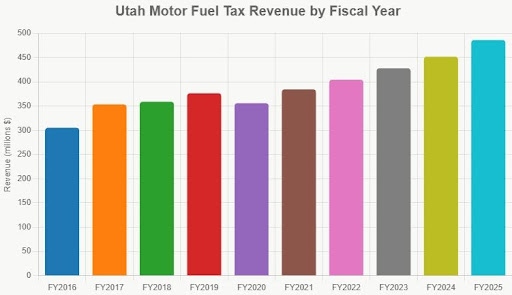
Under state law, the formula is capped so the gas tax cannot continue to rise without a vote of the Legislature—an important safeguard to prevent tax increases from running on autopilot. Under the current formula, the tax could rise to approximately $0.42 per gallon, but any increase beyond that level would require legislative approval.
We have long supported the gas tax because it functions as a true “user fee.” Those who use the roads pay for their construction and maintenance through the gas tax: the more fuel you buy, the more you contribute to road upkeep. However, this system has a growing flaw. As vehicles become more fuel-efficient and increasingly electrified, gas tax revenues become less reliable. While electric vehicles do pay additional registration fees to account for their use of the roads, better methods should be considered to preserve the user-fee principle.
Programs such as Road Usage Charges (RUC) or tolling should be explored to ensure that those who use the roads are paying for them, and that the state’s general fund is not increasingly burdened with road costs as gas tax revenues fail to keep pace with demand.
These proposals are currently under consideration and being examined by the state. When the appropriate time comes, we look forward to working with legislators to ensure transportation funding remains sufficient, fair, and accountable to Utah’s taxpayers.